
On the True Value of Art: The Wrong Price Tag
The first signs of Art are considered a visual language, a symbolic vessel between past experience and the future. Illustrations to remember what had happened, or how to be prepared for the unknown.
Nowadays we think of Art on a much smaller scale, ignoring its potential. We don’t stop to consider the repercussions an artwork in any format (a painting, a book, a film…) can have on the way we see and experience life. I would be tempted to quote Oscar Wilde’s assertions on how Life imitates Art (The Decay of Lying).
Some time ago, in a conversation between friends, someone asked me whether I knew of an artist he could invest in, a few artworks that would multiply in value in the near future.
Should I have given him my business card? The illustration I used for it, I doubt, makes me appear like a crypto-worthy artist.
Anyway, how can we determine that the value of an artwork will multiply, or that it will find the right audience at the right time?
Approximately ten years ago, walking along the town’s high street, I noticed a side table in the window display of a clothing charity shop. The price was very low, fourteen pounds, so I didn’t hesitate to go inside and ask about it.
The cashier was visibly surprised I was interested. They had probably put it on display thinking it was some fake Asian lacquer, there merely for decoration.
Back then you couldn’t search images online as you can now, luckily, otherwise I wouldn’t have this story to tell.
Once at home, I cleaned it carefully and tried to decipher the symbols and inscriptions, but failed to find its origins. Time passed, and it became a place to rest my books, teapot, and cups.
In 2018, whilst preparing for a trip to Myanmar, I happened to notice the Burmese script in the travel guidebook. Could it be the same as on the side table? I took some photos of it, just in case I had the chance to ask a local during those weeks.
Among the many beautiful temples I encountered was a Lacquer Museum in Bagan. It was small, only a few rooms. The staff were kind, so I showed the photos to one of them. He was struck by the beauty of the piece and translated the inscriptions for me, confirming it had been made there, probably in the early-to-mid 20th century.
It was far more impressive than most of the items on display. I felt uncomfortable, I didn’t tell him it was in my possession back in London; it would have made me look like a pirate. How could I have explained myself without getting lost in translation?
Now I can recognise the motifs; the Burmese dancers, the clothing, the symbolism of the animals, such as the bats on the foldable legs. But as I mentioned, anyone could now verify its value within seconds through a Google search.
Most of my friends, when I tell the story, suggest I sell it. Sigh… As though I should be desperate. Andersen would be rather disappointed by such an ending to a tale, after all that adventure to discover its true “value.”
I prefer to keep it as a reminder of how capricious and mysterious life can be, and of how such an object can simply be overlooked because it carries the wrong price tag. That can be a trick, a mirage we fall for. Perhaps if we ignore the price tags, we might still see Art in its original nature: to guide us, to connect us, to enrich our lives through what it awakens in us. A fire lit within ourselves, as in the old caves.
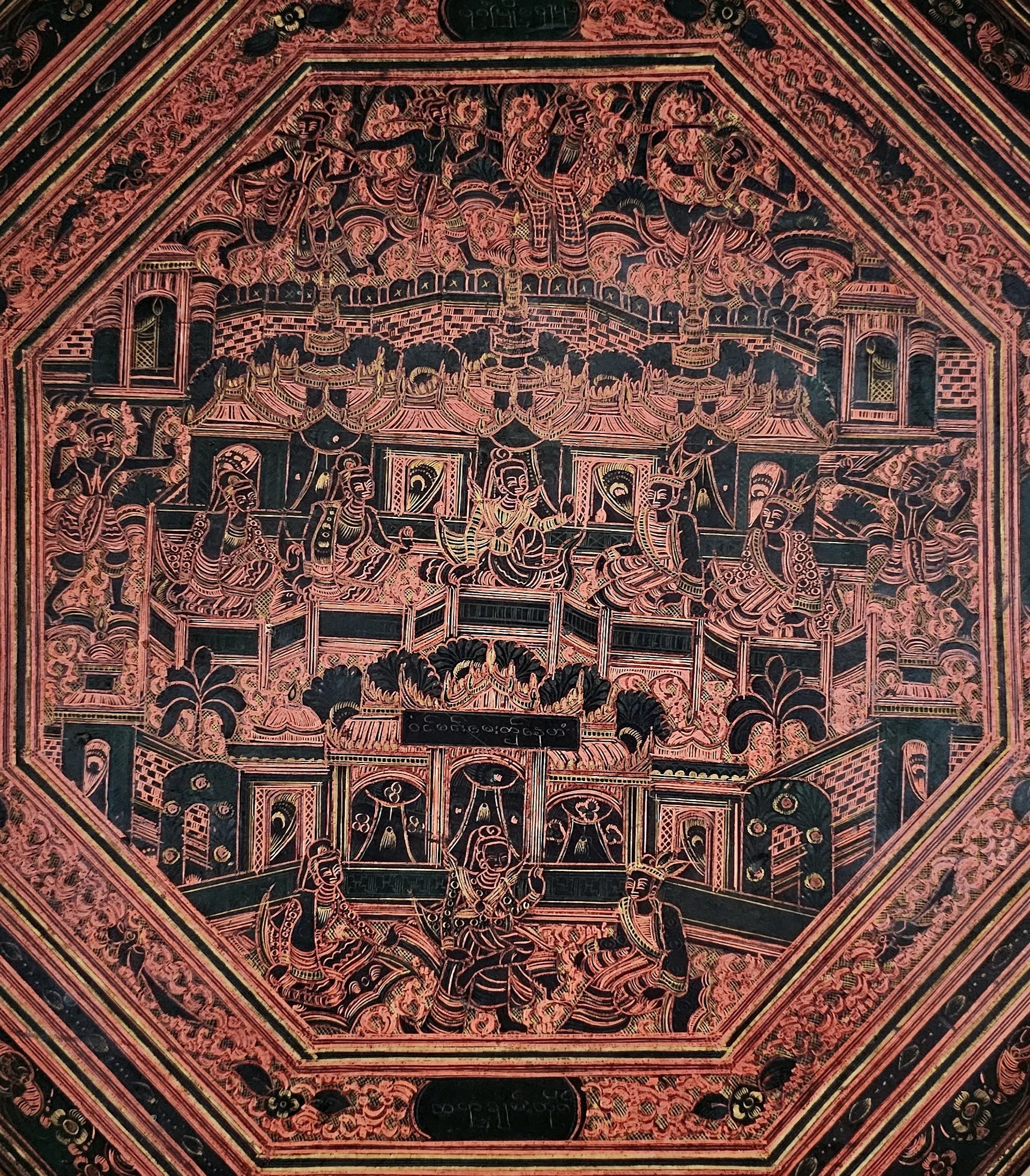
A photo of the Burmese side table.